
Consulting · Team, Leadership & Motivation
Leadership Development: Design & Consulting, Training & Seminars
As a consultancy for leadership development we offer tailor-made leadership seminars, training courses and consulting on design and implementation.
All our leadership training courses are tailor-made and are "hand-crafted" specifically for your strategic business and people development objectives.
We train every level of management.
Consulting & Design of Leadership Development Programmes
Leadership development is an important part of people development. Managers shape the "climate" and the culture of collaboration decisively. Excellent leadership is therefore one of THE most important strategic success factors an organisation has.
Systematic and effective leadership development is the most important building block for that purpose.
Good leadership has to manage strong polarities:
- On the one hand the demands and requirements of the organisation
- and on the other the needs of the people who work in it.
Tailor-made leadership training courses and seminars help to develop your best people so that the organisation's strategic objectives are met as fully as possible.
Design, Training and Consulting
So what you get from us is not "off-the-shelf training" but tailor-made in-house training.
We therefore develop and design your leadership development programmes - tailor-made and matched to your business objectives.
Leadership Training: Our Portfolio
We offer comprehensive consulting on
- 01
the development of leadership development programmes, in content and in strategy
- 02
the design of complete training curricula
- 03
the development and delivery of seminar series
- 04
and individual coaching for managers ("on the job training").
We always tailor the content of our leadership training to your specific strategic needs.
Leadership Development: Criteria for Success
In our view, these four aspects determine the success and the effectiveness of leadership seminars:
Context:
Leadership development is embedded in the wider context of the organisation. The challenges the organisation faces, its objectives, its value system and the existing (leadership) culture are the cornerstones of a programme that fits.
Needs:
The design of the programme follows the development needs of the organisation and of its managers. The requirements and needs of employees are taken into account as well.
Objectives:
The development objectives for qualifying managers are made tangible, achievable and measurable.
Transfer
Putting the content into practice is part of the development itself. Leadership development needs room for experience, for reflection and for exchange with other managers.
Leadership Training: Our Approach
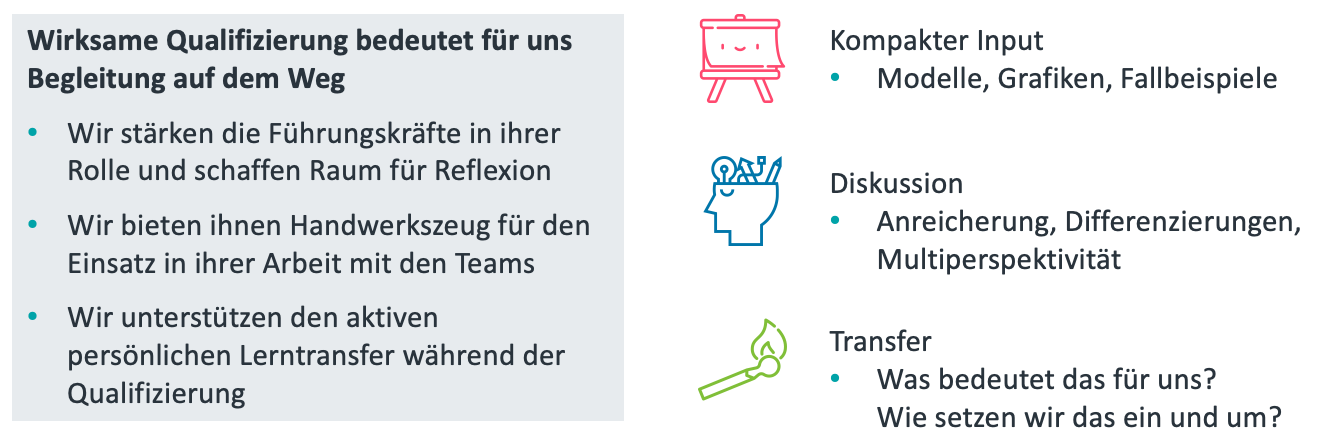
Our training designs are award-winning many times over: interactive, activating learning settings with plenty of variation between
- compact input
- discussion, enrichment, differentiation
- multi-perspective viewpoints
- Transfer into day-to-day leadership
Modules of Our Leadership Seminars
From the following modules of our leadership seminars we will put together a tailor-made curriculum with you, one that fits your challenges, your starting position and your objectives as an organisation:
Training: Principles of Good Leadership
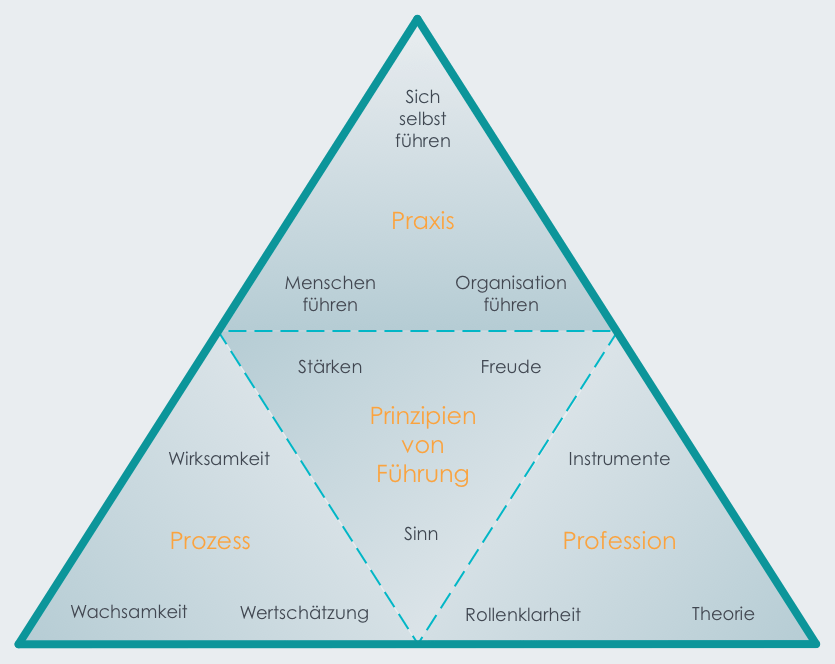
In our leadership training we use these 4 fields of successful leadership as our frame of reference for the content:
- Vision and Strategy
- Vision and strategy are the foundation of good leadership. A clear vision gives the organisation a direction and motivates people to work towards a shared goal. A good strategy describes the route to that vision and sets out the steps needed to reach the organisation's objectives. Managers should be able to communicate the vision and strategy of the organisation in order to inspire and motivate their people. At the same time they should stay open to feedback and suggestions, to make sure that the vision and strategy remain relevant and realistic.
- Leading People
- Leading people well draws on a range of skills aimed at raising performance and engagement. This includes communicating expectations clearly, enabling a positive working environment and creating opportunities to grow. Good managers should be able to recognise the strengths and weaknesses of their people and to coach and support them in a way that advances their individual development. The aim is to give people confidence in their work so that they do their best and the team lives up to its full potential.
- Focus on Results
- A focus on results means that a manager concentrates on measurable outcomes and objectives. Good managers should be able to set and communicate clear objectives and KPIs and to take the steps that keep the team working towards them. This is about using the organisation's resources effectively, setting priorities and reviewing progress regularly to make sure the team is on track.
- Personal Skills
- Personal skills are the foundation of successful leadership. Managers should be able to create a positive working environment and to encourage a culture of collaboration and respect. At the same time they need to be self-reflective, so that they recognise where their weaknesses lie and how they can improve. Emotional intelligence, empathy and openness are equally important skills; they allow a manager to build a relationship of trust and openness with their people. Through continuous learning and growth, managers can extend their skills further and lead their teams to success.
In this article on the principles of good leadership we have set out the model in detail.
Training: Contemporary Leadership
Managers play a key role in establishing and supporting a culture in an organisation that is geared towards continuous development and improvement, and this requires a systematic strengthening of leadership skills and a shared understanding of leadership.
Leadership behaviour that has been tried and tested, or has simply become habit, may no longer work, or may no longer be wanted / appropriate / up to date. Responsibility and structures distributed differently (including flatter hierarchies) and different ways of reaching decisions move managers more and more into the role of a sparring partner, a supporter (facilitator) and someone who provides the guard rails without prescribing the route.
Managers have to deal with a number of competing demands, for example
- changed expectations of the leadership role and of leadership as it is experienced day to day
- the balance between (sometimes necessary) rules / structures and room for "self-determination"
- employees want influence, a say in decisions and recognition
- satisfying one's own interests / needs carries more weight than it used to
These skills become all the more important the faster and more radically the environment around organisations changes.
We have therefore designed a separate block in our leadership programme on leading under volatile and ambiguous conditions:
Training: VUCA Challenges
The VUCA model describes the dynamic and demanding business environment in which managers have to operate today:
Volatility
Markets and client requirements change more often and more quickly. Conditions can shift within a short space of time.
Uncertainty
Volatility means that planning is often no longer possible in the accustomed way. This creates uncertainty and the need to deal far more often with risks and imponderables.
Complexity
As processes and issues become more and more interlinked, complexity rises. Connections can no longer be explained by simple cause-and-effect mechanisms.
Ambiguity
Situations and information are increasingly ambiguous and can even be contradictory. That makes decisions harder, because clear-cut solutions are rarely apparent.
Possible training content on dealing with VUCA:
- VUCA basics:
- An introduction to the VUCA model and what it implies for modern leadership
- Agile leadership:
- Principles and tools of agile management for acting quickly, effectively and flexibly in a VUCA environment.
- Decision-making under uncertainty
- Methods and techniques for making better decisions in complex and unpredictable situations.
- Risk management
- Identifying, assessing and prioritising risks, and developing strategies to mitigate them.
- Emotional intelligence:
- Working with one's own emotions and those of others, in order to improve collaboration and communication in uncertain and stressful situations.
- Resilience and coping with stress
- Techniques and strategies for becoming more robust in the face of change and for reducing stress.
- Systemic thinking:
- Skills for recognising complex connections and interdependencies in organisations and acting accordingly.
- Innovation management:
- Methods and techniques for encouraging creativity and innovation within the team, so that it is better prepared for change.
- Communication and conflict management:
- Effective communication techniques for working through friction and encouraging collaboration in the team when the situation is unclear.
- Change Management
- Processes and strategies for implementing organisational change quickly, in order to respond successfully to VUCA challenges.
- Networking and stakeholder management:
- Building and maintaining relationships with internal and external stakeholders, in order to create synergies and work together effectively in VUCA environments.
- Self-reflection and continuous learning:
- Developing the ability to reflect on oneself and to keep learning throughout working life, so as to adapt continually to changing VUCA conditions.
Training: Remote and Hybrid Working, Generation XYZ
Alongside VUCA phenomena such as volatility and complexity, managers increasingly face generational differences and leadership in remote and hybrid settings. They have to fulfil their role under these conditions too: giving direction, motivating and retaining people, making sure collaboration works and works efficiently, and so on.
The central challenges here are:
Communication & team rules
Managers have to establish clear communication processes and channels and ensure transparency and smooth collaboration, so that all team members are kept in the picture and stay "on board".
Transparency & allocation of tasks
In remote teams it can be difficult to keep track of each person's workload and priorities. Managers should make sure that team members manage their time and resources effectively, so as to avoid burnout and stress.
Technology & infrastructure
Tools and platforms that follow common usability standards are decisive for the success of remote teams. Managers have to agree sensible standards of use and communication with their teams.
Retention & motivation
Motivating and retaining people in remote teams can be harder because of the physical distance and the limited social contact. Managers have to find ways to encourage engagement, to let people build people's sense of self-efficacy and to make sure the team works well together.
Cultural differences & time zones
The members of a remote team may come from different cultures and time zones. Managers need to be aware of these differences and may have to introduce more flexible working-time models, to make collaboration and communication across time zones and cultural boundaries easier.
Agile principles in teamwork:
Many of the challenges described here can be addressed and improved with agile methods of collaboration.
Onboarding & further development
Managers have to design well thought-out onboarding and development programmes that help new team members settle into their roles quickly and keep developing.
Possible seminar content on hybrid collaboration
- Leading remote and hybrid teams
- Building trust and collaboration in remote and hybrid teams
- Methods, tools and techniques for effective communication and transparency in remote and hybrid teams
- Technology and infrastructure for remote and hybrid teams
- Choosing suitable technologies and platforms for remote and hybrid teams
- Best practice for efficient and secure use of technology in remote and hybrid teams
- Training and support
- Agile principles and methods for remote and hybrid teams
- Introduction to agile methods and principles for remote and hybrid teams
- Applying Scrum, Kanban and Lean in remote and hybrid working environments
- Agile values and practices for effective teamwork and flexibility
- Retention and motivation in remote and hybrid teams
- Recognising and addressing barriers to engagement and motivation
- Best practice for supporting work-life balance and employee wellbeing
- Strengthening team spirit in remote and hybrid settings
- Creating an inclusive working environment for all generations and continents
- Onboarding, further development and building skills
- Planning and implementing onboarding programmes for remote and hybrid teams
- Encouraging continuous learning and the development of skills in remote and hybrid teams
- Establishing mentoring programmes and knowledge sharing
- Intercultural skills and managing time zones
- Raising awareness of cultural differences and intercultural communication
- Strategies for dealing with different time zones and working hours in transcontinental teams
- Encouraging cultural integration and collaboration
- Adapting leadership styles and communication strategies to cultural differences
Training: Vision, Purpose, Clarity
Vision
A shared vision and shared objectives strengthen the motivation to put the necessary development steps and changes into practice.
Understanding
Information and situations have to be placed in context so that everyone understands them. Only then can a feeling of uncertainty turn into shared understanding.
Clarity
Clear and unambiguous statements about objectives and expectations give direction. Clear communication also builds trust and creates the basis for successful collaboration.
Training: Agile Leadership
Being an agile organisation means
- being nimble
- a high capacity to adapt to new complexities in the environment around the organisation
- thinking and acting in shorter cycles of planning and delivery
- opening up lasting room for manoeuvre at every level of the organisation
- establishing a high degree of personal responsibility as a core feature of the corporate culture.
This overview illustrates the difference between agile leadership and a traditional understanding of leadership:
- A traditional leadership approach rests on hierarchy, command and control. An agile leadership approach relies instead on empowerment, autonomy and adaptability
- Traditional leadership values planning and forecasting, while agile leadership fosters adaptability
- Agility relies on empowerment, builds the capacity to change, calls for collaboration across lines and hierarchies and a strong focus on the client
- In an agile environment, managers act as coaches and facilitators rather than as authority figures and decision-makers
This gives rise to the following areas of consulting:
- Organisational development and design (e.g. introducing flat hierarchies)
- Coaching and training in agile leadership principles
- Team collaboration and communication (encouraging openness, transparency and collaboration)
- Implementing agile methods and processes (e.g. Scrum, Kanban)
- Cultural change (fostering a learning culture that is learning from its mistakes, a culture of innovation and the processes to support it)
- Performance management (moving from individual objectives to team objectives, continuous improvement)
- Encouraging initiative, self-organisation and personal development
Based on these requirements we have developed a seminar curriculum "agile leadership", from which we identify and combine with you the modules that fit your objectives:
Possible seminar content in our agile leadership training
- Introduction
- to agile working and agile leadership
- Differences
- between traditional and agile leadership
- Agile mindset and culture:
- How to implement agile values and principles in your organisation
- Agile project management:
- How to use agile methods and tools in leadership
- Agile teams:
- How to build, lead and coach agile teams
- Communication in agile teams:
- How to communicate effectively with your teams and give feedback
- Agile leadership in practice:
- How to implement agile leadership successfully in your organisation
- Scrum:
- An introduction to the agile framework Scrum and how to use it in leadership
- Kanban:
- An introduction to the agile framework Kanban and how to use it in leadership
- Agile change:
- How to deliver agile change successfully in your organisation
- Agile culture and values:
- How to foster and strengthen agile culture and values in your organisation
- Agile leadership in the context of digital transformation:
- How to lead in an agile way and keep pace with the rapid change in the world of work
- Agile leadership and self-organisation:
- How to encourage and support self-organisation in your teams
- Agile leadership:
- How, as an agile leader, to build trust, motivation and engagement in your teams
- Agile meetings:
- How to design and use agile meetings effectively
- Agile conflict resolution:
- How, as an agile leader, to resolve conflicts in your teams and create a constructive working environment
- Scaling agile:
- How to scale agile methods and frameworks to enterprise level
- Agile architecture:
- How to apply agile thinking and practice in the development of IT systems and architectures
- Agile strategy:
- How to develop and deliver agile strategies to keep pace with the rapid change in the world of work
- Agile knowledge management:
- How to use agile methods and tools to share and extend knowledge in your organisation
- Agile transformation
- How to plan and deliver an agile transformation in your organisation and make it last
- Agile leadership and employee retention
- How agile leadership can raise retention and satisfaction among your people
- Agile leadership and innovation:
- How to use agile methods and an agile mindset to drive innovation in your organisation
- Agile leadership and client focus:
- How, as an agile leader, to align your teams with the needs and wishes of your clients and achieve high client satisfaction
Training: Leading in Change
Some of the central challenges for managers in change processes are:
- 01
Creating readiness for change: Conveying why the change is necessary and building acceptance
- 02
Developing vision and strategy: Working out a clear and inspiring vision for the change and designing a strategy that can succeed
- 03
Communication and transparency: Maintaining open and transparent communication to avoid misunderstandings and uncertainty
- 04
Employee participation and involvement: Involving people actively in the change process and taking their views and ideas into account
- 05
Emotional intelligence and empathy: Responding to people's concerns, fears and needs and offering them support
- 06
Managing resistance and conflict: Recognising resistance to change and working through it constructively; spotting conflicts early and resolving them
- 07
Motivation and engagement: Creating a motivating working environment that encourages initiative and a willingness to perform
- 08
Innovation culture and creativity: Creating an environment that supports change and encourages new ideas and innovation
- 09
Adaptability and agility: Developing flexibility and the ability to respond quickly to change inside the organisation or in the market
- 10
Virtual teams and remote working: Mastering the new challenges and opportunities that come with leading virtual or distributed teams
- 11
Resource management: Using and prioritising resources effectively in order to steer the change process successfully
- 12
Measuring success and continuous improvement: Measuring progress and success in the change process, learning from mistakes and making adjustments to ensure continuous improvement
The following modules of our curriculum provide the skills and tools needed to face these challenges with confidence:
Possible content of the Leading in Change training
Overview
The significance, the basics and the dimensions of leadership in change processes
The role of the manager
Giving direction, working through friction, managing asynchronicity and much more
Strategic thinking and planning:
Developing a clear vision, mission and objectives for the change
Successful change strategies:
Delivery and "best practice" approaches
Change management tools and techniques:
Tools, formats, change landscapes
Change communication and transparency:
Proven synchronous and asynchronous formats & platforms
Emotional intelligence and empathy:
The human side of leadership in change
Involving and motivating people:
Encouraging participation
Conflict Management
Using disagreement and resistance as a resource
Motivation and engagement:
Encouraging initiative and a willingness to perform within the team
Encouraging innovation and creativity:
Creating an environment that supports change and allows new ideas
Leading virtual teams:
New challenges and opportunities
Resilience and agility:
Embedding adaptability, strengthening the social system for the long term
Measuring success and continuous improvement:
Learning from mistakes
Training: Resilience as a Leadership Skill
In times of rising complexity in the environment and an ever-increasing pace of development, we need resilient organisations, managers and employees. Strengthening resilience makes them more resilient to strain and pressure and preserves and supports organisational performance, one's own performance and that of employees for the long term.
With our resilience training we enable managers to develop and deliberately foster resilience on three levels: the organisation, the person and leadership.
Possible content of the resilience training
- Clear vision, mission and values
- The stormier the times, the stronger the points of reference need to be.
- Adaptive leadership behaviour
- Navigating the organisation and oneself through complex and rapidly changing demands
- Fostering agility
- Encouraging decentralised decisions and a culture in which people take responsibility, so that new challenges can be met quickly.
- Establishing a strong culture of learning
- and innovation: Fostering a culture that supports continuous learning, experimentation and innovation.
- Robust structures and processes
- Implementing flexible and scalable structures & workflows to ensure flexibility and organisational agility.
- Empowerment at every level of the hierarchy
- People at every level take the right decisions on their own; establishing a positive learning culture that is learning from its mistakes, and a learning organisation.
- Building networks
- Building and maintaining internal and external networks to extend the pool of resources and to provide support in times of crisis.
- Risk management: identifying, assessing and minimising risks proactively, in order to spot possible disruptions in advance and develop adequate countermeasures.
- Psychological safety: creating an environment in which people see mistakes as chances to learn and dare to voice ideas, concerns and opinions openly.
- Building employee resilience: investing in people's personal and professional development in order to raise their individual resilience and performance.
- Speed of response: developing the ability to react quickly and effectively to change and to unforeseen events.
Training: Opening a Space for Dialogue - Leading from Multiple Perspectives
Working from multiple perspectives means bringing different points of view, opinions and experiences from different disciplines, cultures and backgrounds into a working or decision-making process. This "bottom-up" approach produces a 360-degree view of a problem or a situation by bringing different perspectives together and analysing them.
Research suggests that working from multiple perspectives
- leads to better solutions and greater value creation in organisations
- raises the speed of delivery in the agreed actions and fields of activity
- increases employee satisfaction over the medium term and lowers the rate of resignations
- produces significantly better ratings for managers who lead this way in 360-degree feedback processes.
Suggested training content on leading from multiple perspectives
01
The basics of opening a space for dialogue:
02
Active listening and empathy:
03
Leading from multiple perspectives:
- Valuing different thinking styles and perspectives
- Collaboration and team dynamics in diverse teams
- Fostering creativity and innovation by working from multiple perspectives
- Integrating different approaches for effective problem-solving
04
Decision-making and problem-solving:
05
Case studies and best practice:
- Analysing successful practice in working from multiple perspectives
- Applying what has been learned to real case examples
- Reflecting on and critically examining existing practice
- Developing strategies for implementing the insights in your own organisation
Training: New to Leadership
Possible training content for new managers
Introduction to leadership
- The role of a manager
- Basic leadership styles and approaches
- Leadership ethics and values
- Ruth Seliger's leadership principles
Authenticity and self-assurance
- Self-reflection and personal development
- Values-based leadership
- Resilience and coping with stress
- Time management and prioritisation
Decisiveness and responsibility
- Decision-making under uncertainty
- Delegation and responsibility
- Risk management
Vision, strategy and inspiration
- Strategic planning and alignment
- Developing a vision and a mission statement
- Inspiring and motivating people
- Reaching long-term objectives
Building relationships and communication
- Effective communication techniques
- Empathy and emotional intelligence
- Giving and receiving feedback
- Conflict management and conflict resolution
- Encouraging teamwork
Raising performance and developing people
- Recruiting and integrating new employees
- Developing and supporting employees
- Performance management and objective agreements
- Recognition and appreciation
Problem-solving and the capacity to innovate
- Creative thinking and innovation
- Problem-solving processes and methods
- Change management and organisational development
Focus on delivery and results
- Project management and prioritisation
- Continuous improvement processes
- Measuring success
Networking and managing relationships
- Internal and external networking
- Stakeholder management and communication
- Leadership networks and further development
Close and reflection
- Criteria for success and further development as a manager
- An individual action plan for putting it into practice at work
- Closing discussion and exchange
Training: Developing Shared Leadership Principles
Workshops for leadership teams:
- A shared understanding of leadership
- Guidelines / leadership principles for a (changed) leadership culture
- Examining the demands and challenges you face as a leadership team
- Developing shared leadership objectives
- Strengthening a sense of togetherness as a leadership team
Leadership training planned, looking for advice? We have 21 years of experience!
A free initial consultation on your specific situation.
Leadership Training That Fits: Some Examples
All these modules can be combined freely. We develop a training curriculum that fits your strategic objectives.
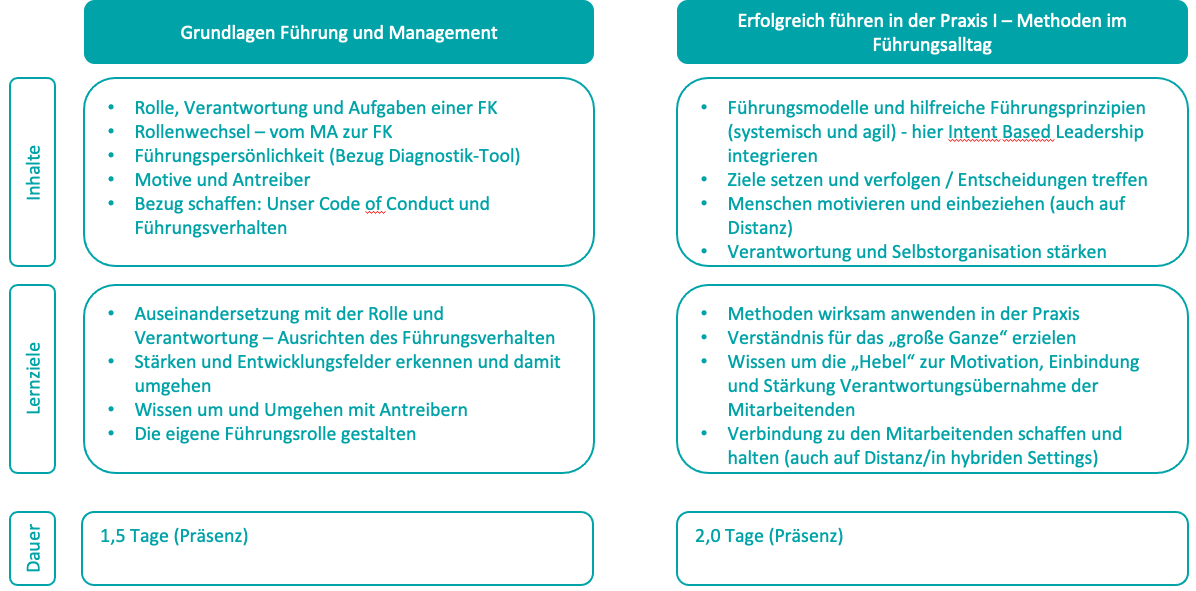
Example curriculum 1
Here is an example curriculum from one of our client projects:
Example curriculum 2
The curriculum above was extended with further modules - see here:
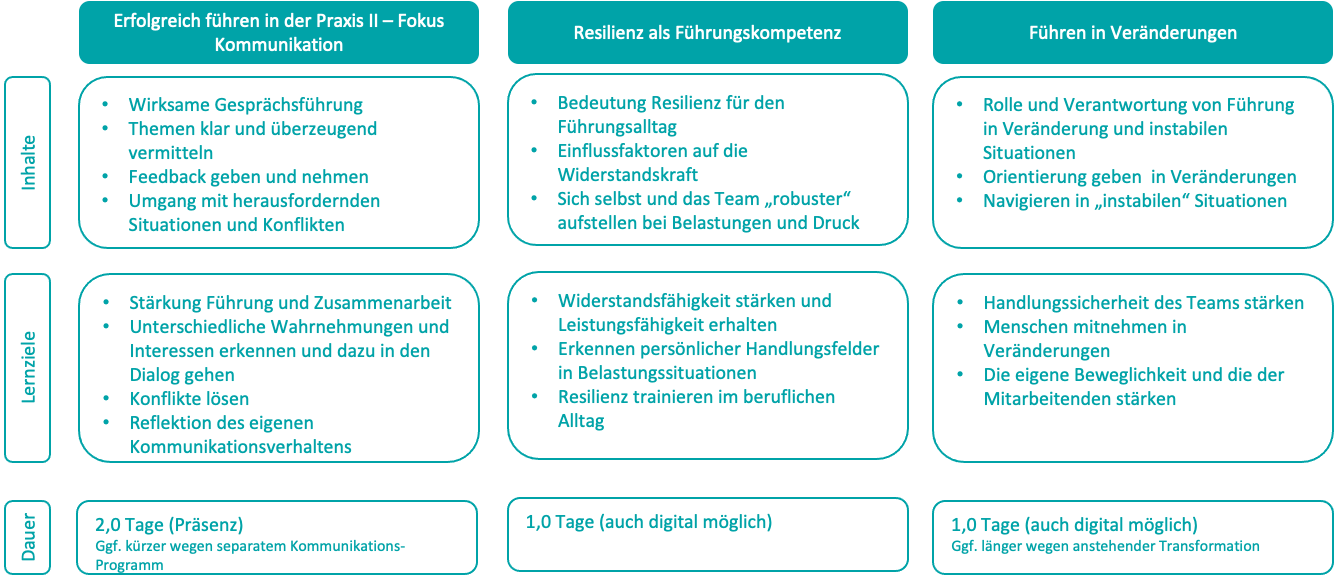
The curriculum in detail
01
Leadership and management basics
Content
Learning objectives
- Examining the role and the responsibility – aligning leadership behaviour
- Recognising strengths and areas for development and working with them
- Knowing your drivers and dealing with them
- Shaping your own leadership role
02
Leading successfully in practice I – methods for day-to-day leadership
Content
- Leadership models and useful leadership principles (systemic and agile) - integrating Intent Based Leadership here
- Setting and following up objectives / taking decisions
- Motivating and involving people (including at a distance)
- Strengthening responsibility and self-organisation
Learning objectives
- Applying methods effectively in practice
- Gaining an understanding of "the bigger picture"
- Knowing the "levers" for motivating and involving people and strengthening their willingness to take responsibility
- Building and keeping a connection with employees (including at a distance/in hybrid settings)
03
Leading successfully in practice II – focus on communication
Content
Learning objectives
- Strengthening leadership and collaboration
- Recognising different perceptions and interests and entering into dialogue about them
- Resolving conflicts
- Reflecting on your own communication behaviour
04
Resilience as a leadership skill
Content
- What resilience means for day-to-day leadership
- Factors that influence resilience
- Making yourself and the team "more robust" under strain and pressure
Learning objectives
- Strengthening resilience and preserving performance
- Recognising your own fields of action in situations of strain
- Practising resilience in everyday working life
05
Leading in change
Content
- The role and responsibility of leadership in change and in unstable situations
- Giving direction during change
- Navigating "unstable" situations
Learning objectives
- Strengthening the team's confidence to act
- Taking people with you through change
- Strengthening your own flexibility and that of your people
An Example Training Architecture
The diagram below shows how the carefully matched elements of our leadership development seminars can be combined into coherent leadership training that builds step by step:
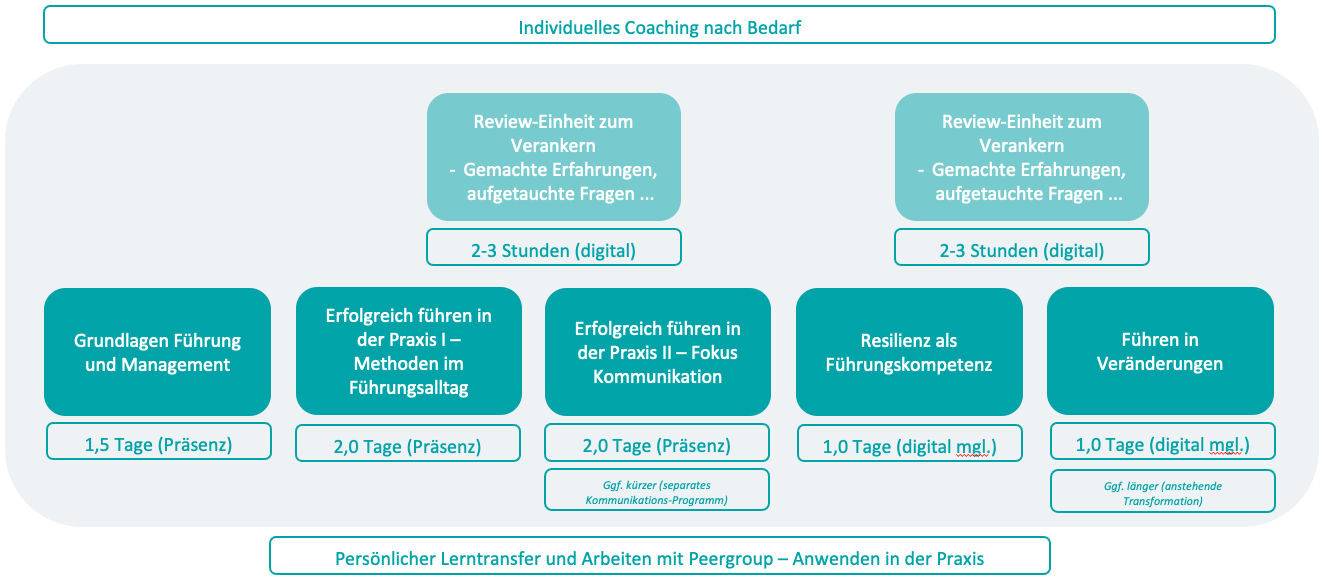
This is a real example from one of our client projects. Your curriculum will of course look different - the challenges and the target picture differ in every organisation.
Try us out and see what your individual curriculum could look like!
How We Develop Leadership Training
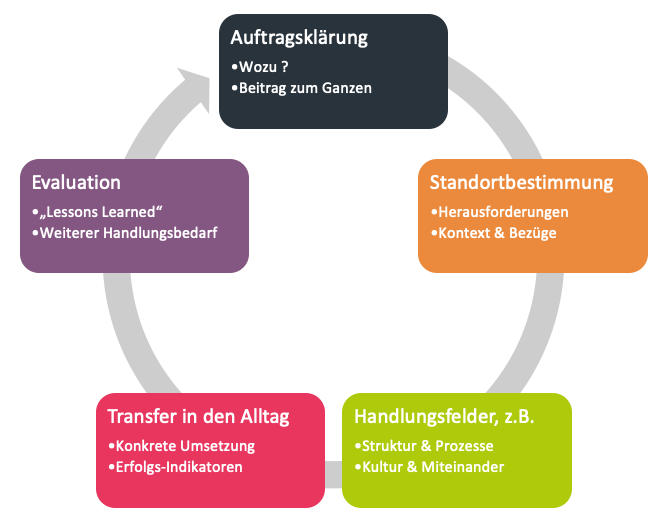
Reaching the organisation's strategic objectives calls for leadership development that fits and, above all, that works.
To get there we work through these five steps with you:
Clarification
As a sparring partner and adviser we first clarify:
- in which context the leadership training takes place
- what contribution the leadership development is to make to the organisation
Taking stock
- What challenges does our organisation face
- which demands on leadership come with them
- Which existing leadership principles or values are already in place
- What are the root causes and reasons for unwanted leadership behaviour and action so far?
Deriving fields of action
The information on context, objectives and the relevant cornerstones of leadership development points to the fields of action:
- What does our organisation want to, or have to, work on when it comes to leadership?
- What does that mean for how we think and act?
Here we look not only at the leadership level, but also at what all this means for employees.
Transfer into day-to-day leadership
For the transfer into day-to-day leadership we then set out which actions will drive the implementation and how we can measure that these activities are having an effect.
Evaluation
For us, evaluation has two dimensions:
- First, after a certain interval the agreed criteria for measuring success are reviewed, as an overall evaluation of the leadership development.
- Second, we see leadership development as a continuous process in which the knowledge built up is reinforced again and again, and in which changed behaviour has to be tried out, tested for its effect and adjusted where necessary.
Consulting, Training and Seminars in Leadership Development
Ask us for an offer for your training and development initiatives. Everything we do is tailored 100% to you, and we put together a curriculum that really fits your requirements.
What you get from us is not "mass-produced", but
- tailor-made content that hits home
- with activating training methods that work.
More on leadership and leadership development
Consulting & training
Want to Learn more?Good leadership & the good manager
Want to Learn more?11 tools for managers
Want to Learn more?Online seminar on leadership development
Want to Learn more?Leadership Journey
Want to Learn more?Collaboration in virtual teams
Want to Learn more?Strengthening teams with a systemic approach to leadership
Want to Learn more?What our clients say
What clients say about working with us
The seminar was very helpful and will stay with me for weeks and months.

Thank you for the excellent training. You set a lot of thinking in motion for me.

A very helpful, well-run workshop. The results served us well through the restructuring phase too.

You prepared our workshop thoroughly and precisely. Both the method and the facilitation fitted our objectives very well. We were able to carry on working very successfully with the results. Many thanks.

Four days of workshop and still playful, creative, inspiring and well structured, with good methodology. Thoroughly recommended.

Thanks again for the excellent workshop — we have already started putting the first ideas into practice, and enjoying it.

Excellent. The workshop participants gave us a feedback grade of 1.6 [where 1 is the top mark] — I hope we can continue this constructive and very enjoyable working relationship.

I thoroughly enjoyed working with you, personally and professionally, and it was a great pleasure to run this workshop with you.

A big thank you for facilitating the workshop. We came out of the day as a team, with a good sense of togetherness and a clearer picture of the way ahead. The workshop was well worth it.

Thanks again for the excellent workshop — we are very happy with the outcome.

That was a really great workshop, thank you.

Thank you for two genuinely good, efficient days. The workshop was received positively throughout. Many thanks for your support.

Free initial consultation
Contact.
We have been developing leadership programmes for 21 years and will design a curriculum that meets your objectives.